In an unpredictable economy, where customers change their preferences overnight and supply chains face unusual disruptions, organisations can no longer afford to rely solely on top-down strategies or elite innovation teams.

Instead, the true competitive edge lies in your people, specifically, in their ability to creatively solve problems in real time, at every level.

Welcome to the age of the Everyday Problem Solver.

The Value of Everyday Problem Solvers

An Everyday Problem Solver is someone who doesn’t wait to be told what to fix, they proactively identify friction, suggest improvements, and take ownership of creating better outcomes.

This mindset and skillset can radically transform performance across every function:

  • Operations: Employees fix inefficiencies before they escalate.
  • Customer Service: Teams turn complaints into insights and service innovation.
  • Sales & Marketing: Reps find smarter, faster ways to connect with the market.
  • HR & L&D: Staff build more human-centered solutions for development and retention.

In short, when your workforce thinks like innovators not just executors you unlock scalable agility and creativity.


Why It Matters Now More Than Ever

Let’s look at the big picture:

  • The World Economic Forum lists “complex problem solving” and “critical thinking” among the top future-of-work skills.
  • A PwC study found that companies with a culture of innovation were twice as likely to report revenue growth over 10%.
  • In South Africa, where businesses face unique challenges in infrastructure, inequality, and skills gaps, innovation at the ground level isn’t just useful but vital for survival.

In a volatile, uncertain, complex, and ambiguous (VUCA) world, agility isn’t driven from the top – it’s built from the bottom up.


From Passive Workers to Proactive Creators

Many organisations were built on efficiency, people trained to follow SOPs, deliver predictable outcomes, and reduce deviation. That worked well in the industrial age.

But today’s workforce faces fast-evolving needs: digital shifts, generational expectations, global trends, and resource scarcity. To thrive, employees must think critically, act independently, and collaborate cross-functionally.

This requires a cultural transformation: moving from “get it done” to “how can we do this better?”


6 Ways to Build a Workforce of Everyday Problem Solvers

  1. Cultivate a Problem-Solving Mindset

It starts with belief: the belief that innovation isn’t reserved for leaders, engineers, or creatives. Every team member has the potential to contribute ideas and improvements.

Train your workforce in:

  • Growth mindset
  • Cognitive flexibility
  • Asking quality questions (e.g. “What’s really going on here?”)

Host reflection moments where teams revisit their biggest challenges and reframe them into innovation opportunities.

🛠 Tool: The “What if…” question wall where every team member adds one idea a week based on reframing an everyday frustration.


  1. Upskill with Simple Creative Tools

Start with bite-sized, applicable tools:

  • Design Thinking: Empathise, define, ideate, prototype, test.
  • Systems Thinking: Understand root causes and interconnected variables.
  • Lean Innovation: Build → Measure → Learn.
  • AI-Powered Ideation: Train employees to use AI to generate and test solutions at scale.

💡 Real example: A logistics firm trained their drivers to use voice-to-text AI tools to log delivery issues. Within a month, fleet route efficiencies improved by 17%.

  1. Create Micro-innovation Challenges

Set up “micro-challenges” across departments that ask teams to solve one friction point a month. Provide a template for submission, a timeline, and visible recognition.

For example:

  • “How might we reduce delays in our onboarding process?”
  • “What small changes would make our customer check-in experience feel five-star?”

This builds a sense of agency and creativity, without overwhelming staff.

🏆 Bonus: Let winners present their solution company-wide to boost visibility and pride.


  1. Build Peer Circles for Collaborative Thinking

Innovation is a team sport. The best ideas come when diverse perspectives collide.

Create peer problem-solving circles across functions and levels. Give them a real-world business issue to tackle, and facilitate structured idea jams.

This builds:

  • Cross-functional empathy
  • Collaborative ideation muscles
  • Lateral career understanding

🧠 Tip: Rotate leadership within circles so every member develops confidence to lead and pitch.

  1. Reward Insight and Initiative (Not Just Execution)

People rise to what is recognised. If your organisation only rewards delivery, no one will risk creative thinking.

Shift this by:

  • Acknowledging “Most Valuable Problem Solvers” monthly
  • Showcasing stories of smart pivots, creative saves, or breakthrough thinking
  • Creating a “fail forward” board where teams can share learnings from failed experiments

Culture change starts when problem-solving becomes as valued as performance.


  1. Make Innovation Part of Performance Conversations

Embedding creative thinking into KPIs ensures innovation is not a side hustle but part of the job.

Managers should ask:

  • “What friction points have you improved this quarter?”
  • “What customer or team insights did you act on?”
  • “How did you experiment with new methods?”

This makes innovation measurable, trackable, and repeatable.

📈 Metric examples:

  • Number of team-sourced ideas implemented
  • % improvement in process time or satisfaction score
  • Participation rate in problem-solving activities


The Role of Leadership: From Boss to Enabler

Leaders are the gatekeepers or greenlights of innovation. If they model curiosity, vulnerability, and creativity, others will follow.

What great innovation leaders do:

  • Ask more “how might we?” and fewer “why didn’t you?”
  • Encourage calculated risk-taking
  • Celebrate process, not just perfection
  • Share ownership of solutions (ideas can come from anywhere)

🗣 Try This: Open your next team meeting with, “What’s something you’ve fixed or improved this week, even in a small way?”


Common Barriers to Watch Out For

Despite best intentions, here’s what might hold your organisation back:

  • Fear of failure – “What if I mess up?”
  • Lack of time – “I’m too busy to think creatively.”
  • Hierarchy – “My ideas won’t matter to leadership.”
  • No systems – “There’s nowhere to take my ideas.”

All of these are solvable with the right training, leadership mindset, and recognition systems.


Real Example: Woolworths South Africa

Woolworths launched an internal innovation campaign called “Woolies Ideas,” inviting staff at all levels to submit solutions to customer experience pain points.

  • Over 2,000 submissions were received within 6 weeks.
  • 15 ideas were fast-tracked for prototyping.
  • Several ideas came from retail floor employees, not head office.

The result? Frontline staff felt empowered and heard, and leadership gained a pipeline of customer-centric ideas.


Innovation Starts with Everyday Acts

Innovation doesn’t need to start with a million-dollar budget. It starts when a call centre rep suggests a new way to handle complaints. When a technician prototypes a new checklist. When a team finds a faster way to get results.

These acts may seem small but when multiplied across your workforce, they form the foundation of a resilient, innovative organisation.

The future of business doesn’t belong to the biggest or fastest it belongs to the most adaptable. And adaptability is powered by everyday problem solvers.

🔧 Want to turn your teams into everyday innovators?
🚀 Book your Creative Thinking Bootcamp at ThinkInnovator.com and ignite the mindset shift your organisation needs.
 

Innovation is a powerful driver of growth and success, yet many organisations struggle to achieve lasting results despite their investments. Whilst innovation efforts fail due to various barriers some are external, but many are internal. Understanding why these efforts fall short and addressing key areas for improvement can significantly enhance the likelihood of success.

These are some of the primary observations we have made as to why innovation initiatives falter and we have outlined strategies that can help organizations develop a culture of sustainable innovation.

1.Lack of Clear Strategy and Goals

The Problem:

One of the biggest pitfalls in innovation efforts is the absence of a well-defined strategy and clear, measurable goals. When innovation initiatives lack focus, they risk devolving into ad-hoc projects with little alignment to the organization’s broader mission or objectives. As a result, teams may invest time and resources in projects that ultimately don’t contribute value or align with the company’s vision.

The Solution:

To create a lasting impact, innovation efforts need to start with a clear vision and strategy. Your organisations should:

  • Define what innovation means for you and outline how it supports your goals.
  • Identify specific areas or problems that innovation will address.
  • Set measurable goals and KPIs that allow teams to track progress and track the effectiveness of initiatives over time.

A clear, unified vision can help direct innovation initiatives, align team efforts, and foster buy-in across the organization.

2. Limited Investment in Skills and Training

The Problem:

Innovation demands more than just ideas it requires great quality ideas and a workforce equipped with the right skills to turn these ideas into reality. Yet, many organizations overlook the importance of ongoing training and skill development. Without the necessary creative, problem-solving, and technical skills, teams may struggle to bring innovative concepts to life.

The Solution:

A commitment to upskilling can pay enormous dividends in innovation capability. Organizations should consider:

  • Creating a robust training program that focuses on innovation and related skills
  • Involving employees in cross-functional projects to encourage knowledge-sharing and adaptability.
  • Investing in external partnerships with consultants, or specialized training providers to access expertise and resources that may not exist in-house.

In addition, organisations that foster an open learning culture can build a workforce that is resilient and ready to adapt to rapidly changing innovation landscapes.

3. Inadequate Leadership and Support

The Problem:

Innovation cannot flourish without strong support from leadership. Leaders who view innovation as a side project, rather than a core function, are unlikely to allocate the resources and encouragement teams need to succeed. Additionally, leaders who punish failure or are overly risk-averse inadvertently create a culture that stifles experimentation.

The Solution:

Leaders play a critical role in fostering an innovative culture by:

  • Championing innovation as a strategic priority and aligning it with the company’s long-term objectives.
  • Providing necessary resources from financial investment to time and, tools to support teams in their innovative endeavours.
  • Encouraging a culture of safe experimentation where calculated risks are supported and failures are viewed as opportunities to learn.
  • Leading by example and nurturing the teams innovation capabilities with harnessed capabilities and skills

When leaders model a commitment to innovation, they set the tone for the rest of the organisation, giving teams the confidence to pursue bold ideas.

4. Resistance to Change and a Fear of Failure

The Problem:

Many organisations encounter resistance from employees who are comfortable with the status quo or fearful of the risks that accompany innovation. This resistance can be deeply ingrained in the organisational culture, particularly in legacy companies or industries with a history of rigid processes. A fear of failure often paralyzes teams, causing them to prioritise safe ideas over transformative solutions.

The Solution:

Building a culture of psychological safety is essential for overcoming resistance to change. Organisations can support this shift by:

  • Encouraging open dialogue around the benefits and challenges of innovation.
  • Celebrating both successes and failures to reinforce that each outcome is valuable for learning and growth.
  • Involving employees in innovation decisions to increase their ownership and willingness to embrace new ideas.

By reframing innovation as a series of iterative steps rather than a one-time leap, companies can reduce fear and increase employee engagement.

5. Siloed Teams and Poor Cross-Functional Collaboration

The Problem:

Innovation thrives on diverse perspectives and knowledge-sharing. However, in many organizations, teams operate in silos, disconnected from other divisions. When teams lack collaboration and visibility into each other’s work, they miss opportunities for synergy and alignment. This can lead to duplicate efforts, wasted resources, and missed opportunities for cross-functional innovation.

The Solution:

Fostering cross-functional collaboration is essential to breaking down silos. Companies can:

  • Establish cross-functional innovation teams that bring together members from different departments to work on innovation projects.
  • Encourage job rotations or temporary placements to allow employees to gain a deeper understanding of different functions.
  • Invest in collaborative tools and platforms that enable easy sharing of ideas and updates across departments.

By creating structured opportunities for collaboration, organisations can ensure that innovation benefits from diverse insights and avoid unnecessary duplication.

6. Overemphasis on Short-Term Results

The Problem:

Organisations are often pressured by the demands of quarterly reporting or immediate market performance, which can lead them to prioritize short-term results over long-term innovation. This pressure to deliver quick wins can lead to an emphasis on incremental improvements, rather than transformational changes that require time and sustained effort.

The Solution:

Organisations that are committed to lasting innovation should focus on long-term planning and patience. Key strategies include:

  • Setting long-term innovation objectives that allow for meaningful exploration and experimentation.
  • Allocating resources for “moonshot” projects that, while uncertain, have the potential for breakthrough success.
  • Encouraging a mindset that values incremental progress and learning over immediate profitability.

While short-term wins can help maintain momentum, it’s essential to balance these with investments in projects that may take longer to yield results but have a higher potential impact.

7. Neglecting Customer Needs and Market Trends

The Problem:

Innovation efforts that fail to consider customer needs or ignore market trends often fall flat. Many organisations become singularly focused with technology for technology’s sake or assume they know what customers want without doing the necessary research. This disconnect can lead to products or services that fail to resonate in the market.

The Solution:

Successful innovation is customer-centric and market-informed. Organisations should:

  • Invest in customer research to identify pain points, needs, and emerging trends.
  • Leverage customer feedback loops throughout the innovation process to ensure solutions are relevant and valuable.
  • Monitor competitor innovations and broader market shifts to remain agile and responsive.

By aligning innovation efforts with customer needs and market realities, organisations can increase the likelihood of meaningful impact.

Innovation failures are rarely due to a single factor; rather, they stem from a combination of strategic missteps, cultural barriers, and operational challenges. To foster a thriving culture of innovation, organisations need to approach it as a strategic priority, equip their teams with the skills and support they need, and cultivate an environment where experimentation and cross-functional collaboration are encouraged. Embracing long-term thinking, customer focus, and a willingness to learn from failure will enable organisations to transform their innovation efforts from faltering experiments into a sustainable engine of growth and adaptability.

Need help launching or accelerating your current innovation efforts? Email tasneem.mohamed@thethinkteam.com for a free virtual innovation consult.

Innovation has often been perceived as the domain of human ingenuity, but many of the best solutions come from an unlikely source: nature itself. Biomimicry, an innovative approach to problem-solving, it involves studying and emulating the designs, processes, and ecosystems found in nature to develop sustainable and efficient solutions to human challenges. By tapping into the wisdom embedded in billions of years of natural evolution, biomimicry enables us to create technologies and strategies that are not only innovative but also eco-friendly.


In this post, we will explore biomimicry in-depth, provide practical examples of how it has already influenced modern life, and offer actionable steps for leveraging biomimicry to create practical solutions, especially in the context of Environmental, Social, and Governance (ESG) strategies.


What is Biomimicry?

Biomimicry is the practice of looking to nature for inspiration to solve human challenges. The basic premise is that nature, through millions of years of evolution, has already solved many of the problems we face today. From the way organisms create efficient energy systems to the structural genius of natural forms, nature provides countless lessons.


As a design method, biomimicry has three key principles:

  1. Emulating nature’s models: Study the processes, designs, and strategies found in nature, and mimic them to solve human problems.
  2. Using nature as a measure: Evaluate the sustainability of our innovations by comparing them to how nature operates. Nature works in cycles, with no waste, and has been optimizing for resilience.
  3. Viewing nature as a mentor: Rather than exploiting nature, biomimicry encourages us to learn from it. It shifts our perspective from one of domination over nature to one of collaboration.


Practical Examples of Biomimicry in Everyday Life

While biomimicry might sound like a futuristic concept, many innovations we use today are already inspired by nature. Below are several real-world examples:


  1. Velcro: Burrs and Hooks

One of the most well-known examples of biomimicry is Velcro, a product inspired by the tiny hooks found on plant burrs that attach themselves to animal fur. Swiss engineer George de Mestral invented Velcro in the 1940s after noticing how burrs clung to his dog’s fur during a walk. He closely examined the structure of the burrs and used that design to create a fastener system. Today, Velcro is used in countless applications, from clothing to space exploration.


  1. Kingfisher-Inspired Bullet Trains

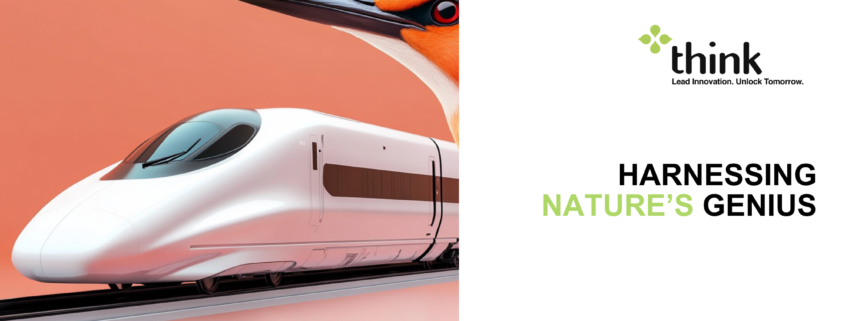
In Japan, engineers faced a significant challenge with the Shinkansen bullet trains: as the trains emerged from tunnels, they caused loud sonic booms due to air pressure changes. Eiji Nakatsu, an engineer and avid birdwatcher, noticed that the kingfisher bird dives into water with barely a splash, thanks to the shape of its beak. He applied this observation to redesign the nose of the train, dramatically reducing noise and improving speed and energy efficiency.


  1. Energy-Efficient Buildings: Termite Mounds

In Zimbabwe, architects designed the Eastgate Centre, a shopping mall and office building, to mimic the natural cooling processes found in termite mounds. Termite mounds maintain a constant internal temperature despite fluctuating external temperatures by using a series of vents to circulate air. The Eastgate Centre uses a similar passive cooling system, reducing the need for air conditioning by up to 90%, making the building highly energy-efficient.


  1. Sharkskin-Inspired Surfaces

Shark skin has tiny, tooth-like scales called denticles that reduce drag and prevent bacterial growth. This discovery led to the development of a material called Sharklet, which is used to create surfaces resistant to bacteria. This innovation is particularly useful in hospitals, where Sharklet surface coverings can help reduce the spread of infections without the use of chemicals or antibiotics.


  1. Butterfly Wings and Color without Pigments

Some species of butterflies have vivid colors not because of pigments, but due to the microscopic structures on their wings that reflect light. These nanostructures have inspired the development of color coatings for various products, such as cars and screens, that do not fade over time like traditional pigments. This innovation can lead to more sustainable products, as fewer resources are needed to create long-lasting, vibrant colors.


Biomimicry for ESG Solutions: Practical Steps for Design

Environmental, Social, and Governance (ESG) considerations have become central to how companies design products and solutions. Biomimicry offers an ideal pathway for creating sustainable ESG strategies, as it naturally aligns with environmental stewardship, resource efficiency, and socially responsible innovation.


Here’s how you can apply biomimicry to design effective ESG solutions:


  1. Identify the Challenge with Clarity

First, clearly define the specific challenge you aim to address. Whether it’s reducing waste, improving energy efficiency, or minimizing your environmental impact, having a well-defined problem is crucial. For example, you might focus on developing packaging that minimizes plastic use, or a product that requires less energy to manufacture or use.


  1. Look to Nature for Inspiration

Once the challenge is clear, research how nature solves similar problems. Start by asking questions like:

– How does nature manage resources efficiently?

– How do ecosystems maintain balance without generating waste?

– What natural processes can I mimic to design a more sustainable product?


For instance, if you are looking for ways to reduce energy consumption, study how plants convert sunlight into energy through photosynthesis, or how certain organisms store energy for later use.


  1. Collaborate with Biologists or Ecologists

Biomimicry is inherently interdisciplinary. While designers and engineers bring technical expertise, collaborating with biologists or ecologists who understand natural systems can provide fresh insights. This collaboration can help translate nature’s processes into practical, scalable solutions.


  1. Prototype and Test

After identifying nature-inspired solutions, begin prototyping. This might involve creating a product prototype or developing new business processes modeled after nature’s efficiency. Test these prototypes under various conditions, just as nature continually refines and adapts over time.


For example, if you are designing sustainable packaging, you might prototype biodegradable materials inspired by how plant leaves decompose or how mollusk shells are formed from natural minerals. Testing and refinement will ensure the design is both functional and eco-friendly.


  1. Measure Sustainability

One of the most important steps in using biomimicry for ESG solutions is measuring the sustainability of your design. Nature operates in a closed-loop system where waste from one process becomes the input for another. As you develop your solution, evaluate how it mimics this regenerative cycle. Is the product or process waste-free? Is it energy-efficient? Can it be easily recycled or composted? These criteria will help ensure that your biomimetic innovation aligns with ESG goals.


  1. Implement and Educate

Once the biomimetic solution is ready for implementation, integrate it into your company’s product or service offerings. At the same time, educate your team and stakeholders about the benefits of biomimicry and the specific natural systems that inspired the solution. This awareness fosters a greater appreciation for sustainability and innovation across the organization.

Biomimicry offers a powerful lens through which to view and solve the pressing challenges we face today. By emulating nature’s time-tested strategies, we can create solutions that are not only innovative but also sustainable, resilient, and efficient. The practical examples of Velcro, bullet trains, and energy-efficient buildings demonstrate how biomimicry is already shaping the world around us.


In the context of ESG, biomimicry holds immense potential for creating environmentally responsible products, processes, and policies. By following the practical steps outlined above, companies can harness nature’s genius to drive sustainable innovation, reduce their environmental footprint, and build a better future for all.

At think Innovator not only do we encourage the use of biomimicry for solution and product design, we also train teams how to tap into nature and it’s inherent qualities to unlock new ideas to everyday challenges encountered.

Artificial Intelligence (AI) has been advancing at a mind-boggling rate, and its potential applications are vast, impacting sectors from healthcare to finance, education to manufacturing, and art to design.

AI technology is rapidly transforming the way we live, learn and work. However, there is one area where AI is unlikely to replace human beings: creativity.

Let’s first re-visit the meaning of creativity which can be summed up as the ability to:

  1. Generate new and innovative ideas.
  2. Combine existing ideas in novel ways or connect the dots.
  3. Solve problems in unconventional ways.

Creativity is a uniquely human trait that has driven progress and innovation throughout history. Innovation is essential for survival and growth and while AI technology can process vast amounts of data and make predictions based on patterns, it lacks the imagination, intuition, cultural nuances, historical contexts, and emotional intelligence that are essential for creative thinking.

One of the biggest paradoxes surrounding AI is that its very foundation which is data is also its greatest limitation due to its sole reliance on it.

Algorithms are trained on large data sets, and their outputs are only as good as the data they are fed. This means that while AI can generate variations on existing ideas, it cannot create truly original ideas that break new ground. AI can generate music, art, and literature that mimic existing styles, but it cannot create works that are truly innovative or ground-breaking.

To demonstrate this, let’s look at current AI image and artwork generation platforms, while these platforms can produce images that resemble existing styles of art, such as cubism or impressionism, the images lack the emotion and meaning that are essential to great art.

The same limitations apply to other creative fields, such as music and literature. While AI-generated music can sound good, it lacks the emotional resonance and meaning that comes from human expression. This era of heightened technological advancement has increased the need for genuine human connection, increased personal expression, and a strong sense of belonging – things that AI cannot replicate.

Another limitation of AI is its inability to understand context and culture.

Creative works are not created in isolation but are shaped by the cultural and historical context in which they are created. While AI algorithms can analyse cultural trends and patterns, they lack the deep understanding and empathy that comes from living within a culture. This means that AI-generated works of art, music, or literature can be culturally tone-deaf, lacking the nuances and subtleties that make creative works meaningful and relevant.

For example, in 2018, an AI algorithm generated a script for a Harry Potter movie, based on an analysis of the existing books and movies. The AI-generated script included elements of the Harry Potter universe but lacked the emotional depth, character development, and cultural resonance that make the original books and movies such a hit. Similarly, AI-generated music or literature can lack the cultural relevance and emotional resonance that comes from human emotion and experience.

Another one of the key limitations of AI creativity is its inability to think differently.

Creative thinking often requires taking risks, exploring new ideas, and challenging conventional wisdom. While AI algorithms are designed to optimize existing systems and processes, they lack the curiosity, playfulness, and willingness to take risks that are essential for creative thinking.

For example, in 2019, an AI algorithm created a new colour, “aiqua,” by analysing thousands of existing colours and creating a hybrid. While this was an interesting experiment, it pales in comparison to the human ability to create new colours through experimentation and exploration.

The table below summarises the full extent of the main differences between human creativity and AI-generated creativity:

Emotion and Empathy Human creativity is fueled by emotions, feelings, and personal experiences that resonate with their audiences. AI is devoid of these human characteristics and nuances.
Originality and Uniqueness Human creativity can generate completely new ideas, styles, and forms of expression that have never been seen before. AI-generated creativity can only generate variations on existing patterns and trends.


Cultural Relevance Human creativity is deeply connected to cultural and historical contexts and can capture the subtleties of cultural trends and movements. AI-generated creativity may miss out on cultural relevance or be culturally tone-deaf.
Risk Taking Human creators can take risks, experiment with new ideas, and challenge conventional wisdom. AI can’t push the boundaries of possibility and human ingenuity.
Intuition and Imagination Human creativity relies on intuition and imagination to generate new ideas and connections. The ability to connect seemingly unrelated concepts, and generate unconventional solutions is a uniquely human trait. AI is devoid of intuition and imagination.
Flexibility and Adaptability Human creators can adapt to changing circumstances and adjust their creative process as needed. AI algorithms are rigid and limited by the data they are fed.
Collaboration and Community Human creativity often thrives in collaborative environments where creators can bounce ideas off one another and build on each other’s strengths. AI-generated creativity is a solitary process.
Evolution and Growth Human creativity can evolve and grow over time, building on past experiences, feedback, and new ideas. AI-generated creativity is limited by the data it is trained on and may not be able to grow or evolve in the same way as human creativity.


Human creativity has many strengths that AI-generated creativity cannot replicate, including emotion and empathy, originality and uniqueness, cultural relevance, risk-taking, intuition and imagination, flexibility and adaptability, collaboration and community, and evolution and growth

To demonstrate this notion, I prompted ChatGPT to help me predict the Pantone colour of 2024 and this was its response:

“As an AI language model, I can’t predict the Pantone Colour of the Year for 2024 or any future year. Pantone selects its Colour of the Year based on various factors, including trends in fashion, design, and culture, and the selection process is not publicly disclosed until the announcement is made. Therefore, it’s impossible for me to accurately predict what colour Pantone will choose for 2024 or any other year.”

The limitations of AI creativity, such as its reliance on data, its inability to understand context and culture, lack of emotion and empathy, and its inability to think unconventionally, renders AI as unlikely to create truly innovative, and meaningful work, as demonstrated in the technology’s response to my question.

AI technology should be viewed as a tool that can support and enhance human creativity, providing new insights and tools that humans can build upon and evolve.

The rise of AI prompt engineers validates the notion that what you put in, is what you will get out and it’s ultimately the combination of human creativity and AI technology that has the potential to create a more innovative, imaginative, and creative workplace and world.